Novella · Fyodor Dostoevsky · 1848
White Nights by Fyodor Dostoevsky: Summary & Hindi Audio
Quick Answer
White Nights is Fyodor Dostoevsky’s 1848 classic novella set over four luminous summer nights in St. Petersburg, following a lonely young dreamer and Nastenka. A Hindi audio adaptation narrated by Roshni has begun on YouTube, where Episode 1 (“Pehli Raat”) is currently available.
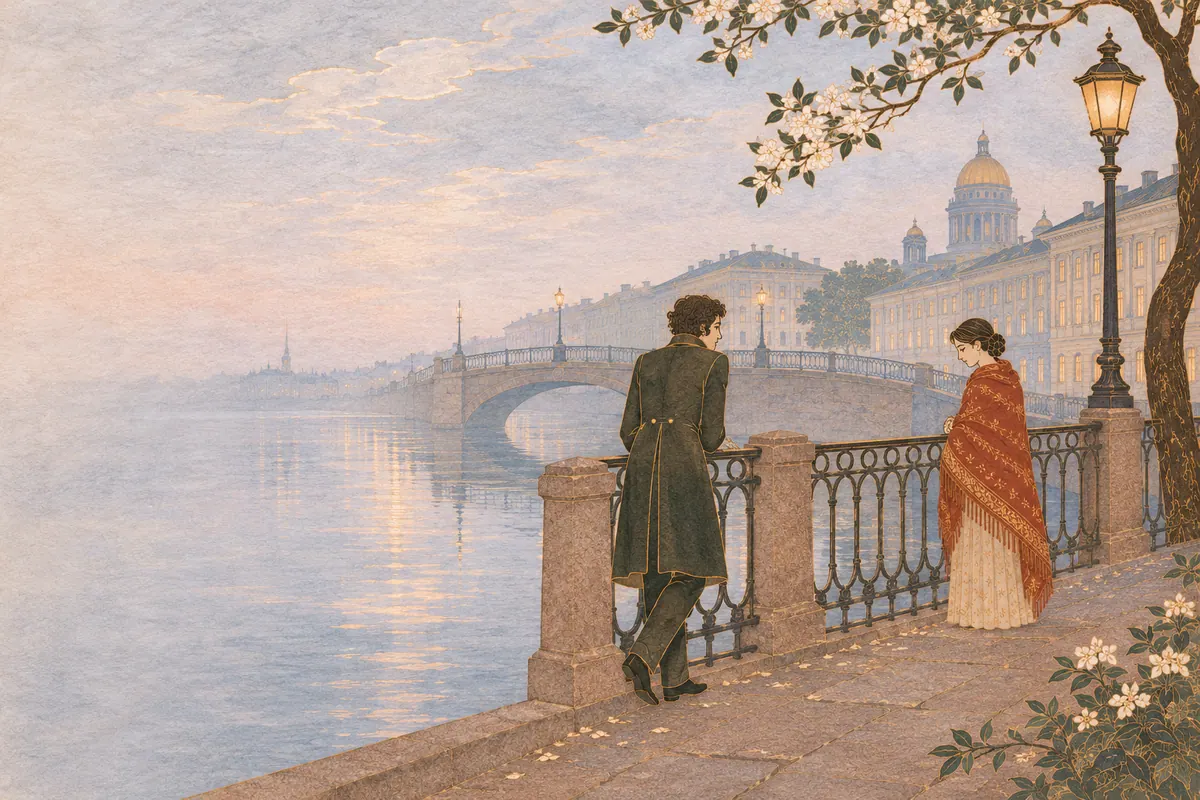
Hello friends, I’m your friend Roshni. Have you ever spent years walking through a crowded city and still felt that not a single soul truly knew you — until one softly lit night by a canal, an encounter with a stranger suddenly breaks years of silence?
Today we look at White Nights, the 1848 novella by acclaimed Russian writer Fyodor Dostoevsky. Its Hindi audio adaptation has begun on Baatcheet and Short Stories with Roshni on YouTube, where Episode 1, “Pehli Raat” (The First Night), is now available to listen to in Hindi.
On this page, you can explore a spoiler-free introduction to Episode 1 alongside the complete summary, characters, and themes of Dostoevsky’s original 1848 novella. Put on your headphones and step into that quiet, pale-lit St. Petersburg night.
Listen in Roshni’s voice (Hindi audio)

Episode 1 ('Pehli Raat' / First Night, ~30 min) is currently available in Hindi audio on YouTube; remaining parts are yet to be released.
White Nights — Spoiler-free summary
Fyodor Dostoevsky’s celebrated 1848 novella White Nights unfolds during St. Petersburg’s summer nights, when the northern sky never goes fully dark and a dreamlike twilight lingers in the air. The unnamed narrator is a lonely 26-year-old who has lived in this great city for eight years without making a single true friend.
He knows the city not through its people, but through the daily rhythms of passersby and the faces of its houses. At home, his only company is his quiet elderly housekeeper, Matryona, and the cobwebs in his room. When summer arrives and the city’s residents leave for their country dachas, he feels as though everyone is abandoning him. That restless solitude sets the mood for Episode 1, “Pehli Raat,” in Roshni’s Hindi audio series.
Around ten o’clock one night, walking beside a canal, he spots a young woman in a yellow hat and black cape weeping alone. At first his shyness holds him back, but when a drunken man follows her, the narrator steps forward with his walking stick and comes to her rescue.
Walking together, they fall into conversation. With disarming honesty, he speaks of his loneliness and the daydream world he inhabits. Sensing she can trust him, the young woman agrees to meet him at the same spot and hour the following night — but on one clear condition: he may be her friend, yet he must not fall in love with her. She also hints that she carries a secret.
Episode 1 (“Pehli Raat”), currently available in Hindi audio in Roshni’s voice, closes right at this intriguing turn. Dostoevsky’s original novella continues across three more nights and a final morning, where the stranger’s secret comes to light and both hearts are tested. Will the narrator keep his promise, and what is the young woman waiting for? Begin by listening to Episode 1 in Hindi.
Full plot summary and ending (spoilers)
This section covers the full plot and ending of the original book. If you are following Roshni’s Hindi audio episode by episode, you may want to save this for later.
Yes, show the full plot and ending
Fyodor Dostoevsky’s original 1848 novella White Nights is structured across four nights and a concluding section titled “Morning.” This complete summary follows Dostoevsky’s original text, while Roshni’s Hindi audio series currently has Episode 1 (covering the First Night) available on YouTube.
On the First Night, an unnamed, solitary 26-year-old narrator has spent eight years in St. Petersburg without a single friend. As summer empties the city toward country cottages, his loneliness sharpens. Around ten at night along a canal embankment, he sees a young woman crying, rescues her from a drunken man, and walks her home. Touched by his gentleness, she agrees to meet him again at ten the next night, on the single condition that he not fall in love with her.
On the Second Night, they meet as promised. The narrator confides how he has drifted away from real life into daydreams and imagination. In turn, the young woman reveals her name, Nastenka, and tells her story. At 17, she lives under the strict watch of her blind grandmother, who once rented a room to a quiet, courteous young lodger. He lent Nastenka books and gradually won her heart. Before leaving for Moscow, he promised that if he were able to marry on returning in a year — and if she still wanted him — he would marry her. A year has now passed and he has been back in St. Petersburg for three days without sending word. Nastenka hands the narrator a sealed letter she has already written, and he agrees to deliver it to the lodger’s acquaintances.
On the Third Night, they wait together for the lodger to appear. Nastenka arrives hopeful, but as the hour passes without him, her spirits slowly sink. The next day brings rain, and Nastenka does not come to meet the narrator. Reflecting on the previous evening, he realizes her joy had rested entirely on hoping to see another man.
On the Fourth Night, the lodger again fails to arrive at the appointed time. Heartbroken, Nastenka breaks down, and the narrator finally confesses his love. She accepts his devotion, and for a brief stretch they imagine building a life together. Just then, a young man walks past and calls out, “Nastenka!” The lodger has returned. She rushes into his arms, turns back for a fleeting instant to kiss the narrator, and leaves hand in hand with the lodger.
On the rainy Morning that follows, the housekeeper Matryona hands the narrator a letter from Nastenka. She begs his forgiveness, writes that she is to marry the lodger next week, and asks that they remain friends for life. The narrator feels no bitterness. He silently blesses her happiness and reflects that a single moment of genuine bliss is enough to fill an entire lifetime.
Key characters
- The Dreamer (Narrator)
- A shy, solitary 26-year-old who has lived in St. Petersburg for eight years without a single true friend. He lives far more in imagination and daydreams than in the real world.
- Nastenka
- An emotional, candid 17-year-old living with her blind grandmother. For a year, she has been waiting for her former lodger to return from Moscow and honor his promise of marriage.
- Nastenka’s Grandmother
- An elderly blind woman who keeps Nastenka under strict supervision and gets by on her pension and the rent from a room in her home.
- The Lodger
- A quiet, polite young man who rented a room in the grandmother’s house. He lent Nastenka books and promised before leaving for Moscow to return in a year and marry her.
- Matryona
- The narrator’s elderly, soft-spoken housekeeper who tends his small room and shares the quiet, unchanging routine of his solitary life.
Themes
Why does loneliness pull people into daydreams?
Fyodor Dostoevsky’s 1848 novella White Nights offers an intimate portrait of isolation and the inner life of a dreamer. Having lived alone in St. Petersburg for eight years, the 26-year-old narrator has grown so detached from real relationships that he silently befriends passing strangers and the city’s buildings. He imagines whole novels in his head, yet trembles at speaking two words to a woman in real life. Dostoevsky shows that when solitude stretches on too long, daydreams offer gentle comfort — yet quietly carry a person even further from lived reality.
Can true love endure without expecting anything in return?
In White Nights, Dostoevsky draws a tender picture of unrequited, selfless love. From the very first night, the narrator knows Nastenka’s condition is that he must not fall in love with her, and that her heart is already waiting for someone else. Even so, he sets his own longing aside, carries her letter to the man she loves, and stands by her night after night. When Nastenka leaves with her returning lodger on the fourth night, no resentment or envy enters his heart — revealing a love rooted in understanding and grace rather than possession.
Is a single moment of joy enough for a whole lifetime?
White Nights (1848) lingers on the weight of fleeting time. The entire novella unfolds across just four nights and one morning, yet those brief hours bring the deepest emotional awakening of the narrator’s life. His four nights with Nastenka fill years of quiet emptiness with warmth, friendship, and color. Even when “Morning” returns him to his cobwebbed room and old silence, he offers no complaint — leaving readers with Dostoevsky’s quiet realization that one true moment of closeness can illuminate an entire life.
How does St. Petersburg mirror the characters’ emotions?
In Dostoevsky’s 1848 novella, St. Petersburg is far more than a backdrop; it reflects the shifting inner weather of its characters. As early summer empties the streets for country estates, the deserted city sharpens the narrator’s solitude. The pale twilight along the canal embankments and quiet bridges lends his meetings with Nastenka the glow of a dream. Then, when the final morning breaks in rain and mist, the same city and Matryona’s room grow cold and hushed once more — letting place and weather speak what the heart feels.
Fyodor Dostoevsky
Fyodor Dostoevsky (1821–1881) stands among the most influential novelists in Russian literature. His writing probes human psychology, loneliness, and inner conflict with rare depth. White Nights (1848) is an early novella, published well before his monumental later works such as Crime and Punishment and The Brothers Karamazov.
Even in this brief story, Dostoevsky’s unmistakable empathy shines through, laying bare the heart of an ordinary, lonely man without pretension. In his hands, the streets of St. Petersburg and its pale northern summer nights become part of the characters’ emotional world.
Why listen to this Hindi audiobook?
Fyodor Dostoevsky’s White Nights is a story best experienced unhurriedly in quiet company, listening rather than rushing through its pages. In Roshni’s calm, gentle Hindi narration, the solitude of St. Petersburg’s luminous nights and the shy tenderness of that first meeting come through with quiet simplicity.
Currently, Episode 1 — “Pehli Raat” (~30 minutes, in Hindi audio) — is available on Baatcheet and Short Stories with Roshni on YouTube, with further parts still to come. Put on headphones during a quiet evening or night, listen to this first meeting in Hindi, and share it with friends if it stays with you.
Frequently asked questions
Who wrote White Nights, and when was it published?
White Nights was written by the renowned Russian author Fyodor Dostoevsky and first published in Russian (Belye nochi) in 1848. It is an intimate love story set in St. Petersburg across four nights and one morning.
Where can I listen to White Nights in Hindi?
You can listen to the Hindi translation of Fyodor Dostoevsky’s White Nights, narrated by Roshni, on the Baatcheet and Short Stories with Roshni YouTube channel. Episode 1 (“Pehli Raat”, about 30 minutes) is currently available in Hindi audio, with upcoming parts planned for future episodes.
Does Episode 1 (“Pehli Raat”) include the entire White Nights novella?
No. Episode 1 (“Pehli Raat”) in Roshni’s Hindi narration covers only the First Night of Dostoevsky’s 1848 novella, when the narrator and Nastenka first meet. The complete original novella spans four nights and a final morning.
How does White Nights end?
In the ending of Fyodor Dostoevsky’s 1848 novella White Nights, Nastenka’s former lodger unexpectedly returns on the fourth night, and she leaves with him. The next morning she sends a letter asking forgiveness and sharing that she will marry him next week; the narrator harbors no bitterness and silently blesses her happiness.
Why is the novella titled White Nights?
In Dostoevsky’s 1848 novella, “White Nights” refers to St. Petersburg’s northern summer nights, when the sky never grows completely dark and a soft twilight lingers. That dreamlike glow frames the four nights the narrator and Nastenka spend together.
Who is Nastenka in White Nights, and what condition does she set?
In Dostoevsky’s White Nights (1848), Nastenka is a 17-year-old living in St. Petersburg with her blind grandmother. She agrees to befriend the narrator on one condition: that he must not fall in love with her, because her heart is already waiting for someone else.
How can Global Indians listen to classic world literature in Hindi audio?
If you live outside India — in the US, UK, Canada, the Gulf, or elsewhere — and want to enjoy world classics in Hindi, you can listen to Fyodor Dostoevsky’s White Nights (1848) in Hindi audio, narrated by Roshni, on Baatcheet’s YouTube channel. It is well suited for reflective, adult classic listening.
Listen next
The Metamorphosis
Franz Kafka
Franz Kafka’s classic 1915 novella The Metamorphosis follows Gregor Samsa, a traveling salesman who wakes one morning transformed into a giant insect, exposing isolation and conditional family love. Listen to the complete 5-part Hindi audiobook narrated by Roshni on YouTube and Spotify.