Short Story · Rabindranath Tagore · 1892
Kabuliwala by Rabindranath Tagore: Summary & Hindi Audio
Quick Answer
Kabuliwala is Rabindranath Tagore’s timeless 1892 Bengali short story celebrating the unlikely friendship between five-year-old Mini and Rahmat, a dry-fruit seller from Afghanistan. Listen to the complete Hindi narration by Roshni on YouTube and Spotify.
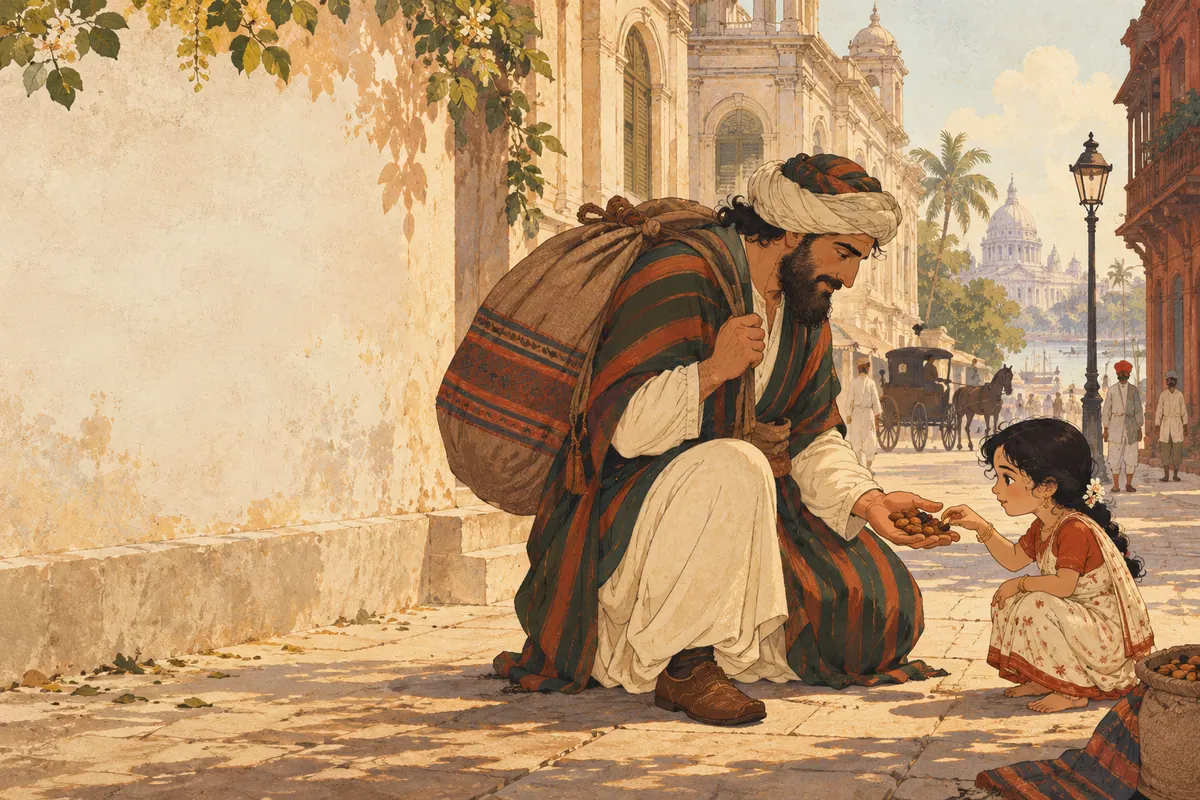
Hello friends, I’m your friend Roshni, back with a story that reaches straight across time and borders into the heart. Looking back on childhood, isn’t it remarkable how certain unfamiliar faces grow to feel like family? Today we walk into the sunlit lanes of nineteenth-century Calcutta, where a bright little girl and a traveler from the mountains of Afghanistan forge an unforgettable bond.
Rabindranath Tagore’s Kabuliwala is far more than words on a page — it captures a father’s unspoken longing in every quiet pause. Put on your headphones, settle in, and experience Mini and Rahmat’s story narrated in Hindi on Baatcheet.
Listen in Roshni’s voice (Hindi audio)

Narrated complete in Hindi as a single episode by Roshni on YouTube and Spotify.
Kabuliwala — Spoiler-free summary
Set in late nineteenth-century Calcutta, Rabindranath Tagore’s Kabuliwala introduces Mini, a vivacious, endlessly talkative five-year-old whose father — the story’s narrator — delights in her curiosity.
One day Mini spots a tall, broad-shouldered vendor from Afghanistan walking down the street in loose clothes with a large sack slung over his shoulder. This is Rahmat, known to everyone as the Kabuliwala. At first Mini is frightened, convinced he hides children inside his sack, until his gentle smile and a handful of almonds and raisins win her over completely.
Soon Rahmat visits every day, and the two share a warm world of laughter and private jokes. Far from home, Rahmat sees in little Mini the reflection of his own young daughter left behind in Afghanistan. While Mini’s cautious mother frets over her daughter’s closeness to a stranger, Mini’s father senses the kindness beneath Rahmat’s rugged exterior.
Then an unexpected turn shatters their quiet routine and alters both their lives for years to come. Without giving away the ending, Kabuliwala shows how deeply human affection transcends age, country, and creed — listen to Roshni’s Hindi narration to let its closing moment land in full.
Full plot summary and ending (spoilers)
If you are experiencing this story for the first time, listen to the Hindi audio on YouTube first — the ending lands best there. Then come back here.
Yes, show the full plot and ending
In late nineteenth-century Calcutta, five-year-old Mini strikes up a cherished friendship with Rahmat, an Afghan dry-fruit peddler who visits her street daily. Overcoming her initial fear after he offers her almonds and raisins, Mini delights in his company and shares playful banter — especially around the word sasural (in-laws’ house), whose meaning she scarcely understands. Rahmat cherishes Mini because she reminds him of his own daughter of the same age back in Afghanistan.
Before Rahmat can return home for the season, an argument erupts with a customer who refuses to pay a debt. Losing his temper, Rahmat stabs the man and is arrested. Even as police lead him away, Mini playfully repeats their joke, before Rahmat is sentenced to years in prison.
Years pass. Mini grows up, makes new friends, and forgets her childhood companion. On the very day of Mini’s wedding, Rahmat is finally released from prison and walks straight to her house, imagining she is still the chatterbox five-year-old he left behind.
When Mini steps out in her bridal finery, Rahmat is stunned into silence. Suddenly he realizes how much time has slipped away — and that his own daughter back in Afghanistan must have grown up too. With tears in his eyes, he shows Mini’s father a smudged scrap of paper he has carried next to his heart all these years: the tiny ink handprint of his little girl.
Deeply moved, Mini’s father recognizes that a father’s love knows no border or creed. Cutting back on the wedding’s lavish lighting and brass band, he hands Rahmat the money to travel home to Afghanistan and reunite with his daughter — closing Tagore’s story on a timeless note of shared humanity.
Key characters
- Mini
- A bright, talkative five-year-old girl whose innocent, unprejudiced affection for Rahmat forms the beating heart of the story.
- Rahmat (Kabuliwala)
- A tall Afghan dry-fruit vendor in Calcutta whose rugged exterior hides the tender, aching heart of a homesick father.
- Mini’s Father (Narrator)
- A writer and thoughtful observer who treasures Mini’s curiosity and ultimately recognizes Rahmat as a fellow father.
- Mini’s Mother
- An anxious, protective mother who worries about her young daughter befriending an unfamiliar foreign peddler.
Themes
The unbreakable bond between father and daughter
Rabindranath Tagore’s Kabuliwala reveals a paternal devotion untouched by distance or borders. Whether a Bengali writer in Calcutta or a dry-fruit peddler from Afghanistan, a father’s love for his daughter speaks the exact same language.
Childhood innocence and the passage of time
Through Mini and Rahmat, Kabuliwala captures both the effortless warmth of childhood and the bittersweet march of years. When Rahmat returns to find little Mini dressed as a shy bride who scarcely remembers him, time’s quiet inevitability hits home.
Life far from home and longing for roots
Tagore gives tender voice to migrants working miles from their families. The smudged paper bearing his daughter’s handprint inside Rahmat’s pocket resonates deeply with anyone who has lived far from home carrying memories of loved ones.
Social prejudice overcome by humanity
While Mini’s mother reflects nineteenth-century suspicion toward outsiders, Mini’s father’s quiet sacrifice on his daughter’s wedding day affirms Tagore’s enduring belief that basic human empathy rises above wealth, class, and nationality.
Rabindranath Tagore
Gurudev Rabindranath Tagore (1861–1941) was one of India’s greatest literary figures and the first non-European to win the Nobel Prize in Literature (1913, for Gitanjali). Writing with remarkable warmth and simplicity about childhood, ordinary lives, and time’s passing, he gave readers Kabuliwala in 1892 — a story still treasured worldwide for proving that human feeling transcends every boundary.
Why listen to this Hindi audiobook?
Rabindranath Tagore’s Kabuliwala is meant to be felt, not rushed. In Roshni’s calm, unhurried Hindi narration — available complete in a single uninterrupted episode on YouTube and Spotify — Mini’s innocent chatter and Rahmat’s quiet longing come alive gently. Put on headphones and share this timeless classic with family and friends.
Frequently asked questions
Who originally wrote Kabuliwala, and when?
Kabuliwala was originally written in Bengali by Rabindranath Tagore and published in 1892. It remains one of his most beloved short stories.
Where is Tagore’s Kabuliwala set?
Rabindranath Tagore’s story is set in late nineteenth-century Calcutta (modern Kolkata), along the city’s streets and inside the home of Mini’s father.
What makes Mini and Rahmat’s friendship so special?
Their bond crosses every divide of age, language, country, and religion. Rahmat treasures five-year-old Mini because she reminds him of his own little daughter waiting back in Afghanistan.
Why is Rahmat the Kabuliwala sent to prison?
Rahmat is imprisoned after losing his temper and stabbing a customer who refused to pay back money owed to him.
How does Kabuliwala end?
Years later, Rahmat is released from prison on the very day of Mini’s wedding. Seeing his daughter’s ink handprint that Rahmat carries, Mini’s father cuts back on the wedding expenses and gives Rahmat the money to return home to Afghanistan and see his own child.
Where can parents abroad share classic Hindi stories like Kabuliwala with their children?
Global Indian families can listen to Kabuliwala narrated in warm, accessible Hindi by Roshni for free on Baatcheet’s YouTube channel and Spotify — an ideal way to keep children close to Hindi and Indian literary heritage.
Listen next
The Postmaster
Rabindranath Tagore
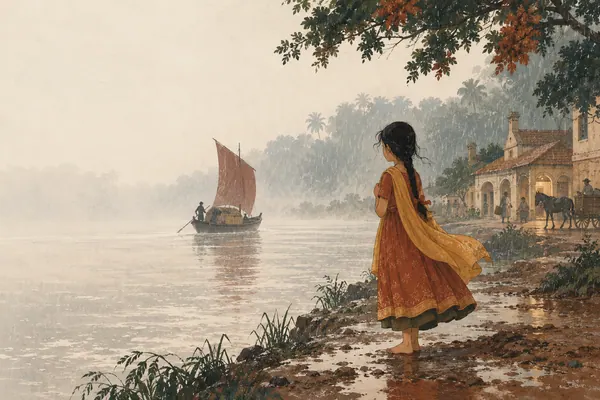
Rabindranath Tagore’s The Postmaster (1891) tells the tender story of a lonely Calcutta clerk posted to a remote Bengal village and Ratan, the orphaned girl who cares for him. Listen to the complete Hindi audio narration by Roshni on YouTube and Spotify.