Short Story · Rabindranath Tagore · 1891
The Postmaster by Rabindranath Tagore: Summary & Hindi Audio
Quick Answer
Rabindranath Tagore’s The Postmaster (1891) tells the tender story of a lonely Calcutta clerk posted to a remote Bengal village and Ratan, the orphaned girl who cares for him. Listen to the complete Hindi audio narration by Roshni on YouTube and Spotify.
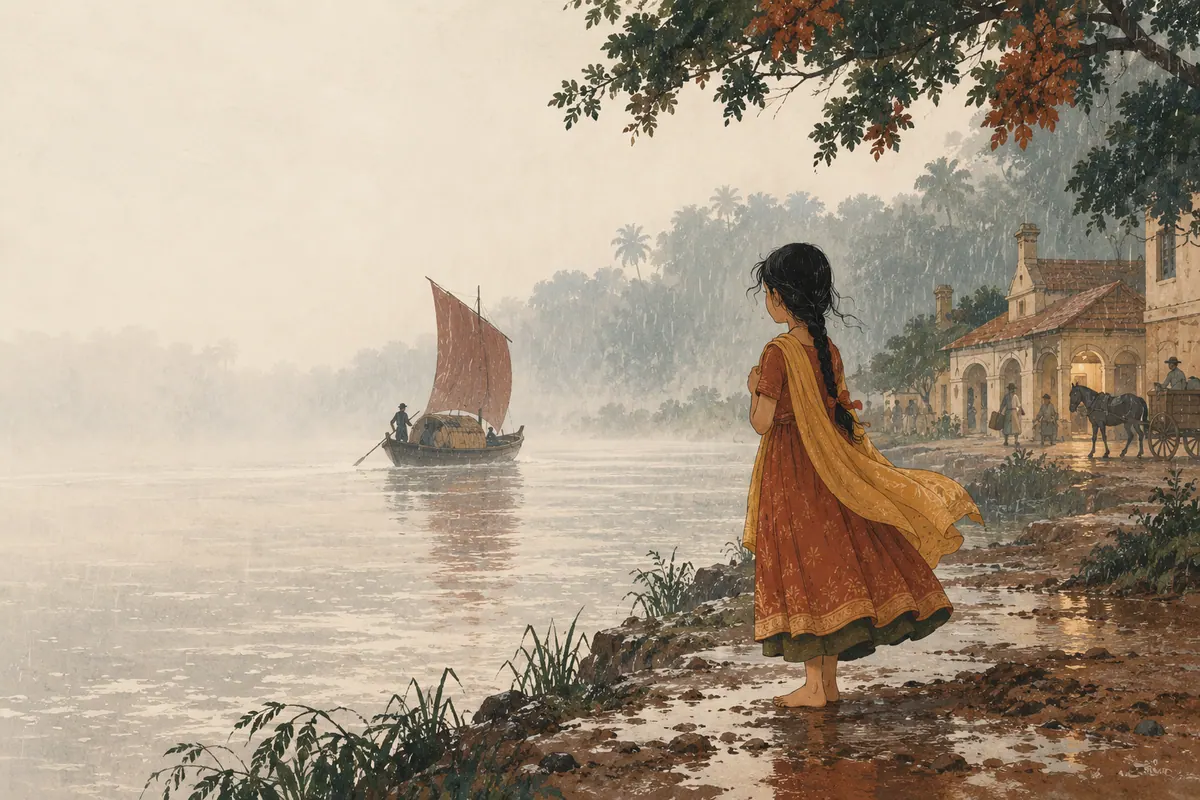
Hello friends, I’m your friend Roshni, back with another story. Sometimes a brief encounter leaves behind a memory that lasts a lifetime — especially when you are deeply alone. Today we travel to Ulapur, a quiet nineteenth-century Bengal village where falling rain quietly weaves an unforgettable bond.
Rabindranath Tagore’s The Postmaster is more than a short story; it captures a quiet ache familiar to anyone who has ever left someone dear behind. Far from the bustle of Calcutta, a young postmaster’s solitude meets the innocence of an orphaned village girl named Ratan. Even miles away from home, hearing such stories in Hindi carries a calm of its own.
So put on your headphones and step into Tagore’s Ulapur — a world where every quiet footstep and unspoken glance matters.
Listen in Roshni’s voice (Hindi audio)

Narrated complete in Hindi as a single episode by Roshni on YouTube and Spotify, with a 40-second preview short.
The Postmaster — Spoiler-free summary
Set in Ulapur, a remote village in nineteenth-century Bengal, Rabindranath Tagore’s The Postmaster follows an educated young man sent from Calcutta to run the local post office. Accustomed to city life, he finds Ulapur dull and isolating, with no educated companions to share his thoughts. In his spare hours he tries writing poetry, longing all the while for the familiar streets of Calcutta.
Into this solitude steps Ratan, an orphaned village girl of about twelve or thirteen who does his household chores. In the quiet evenings, the two begin talking at length. The postmaster asks about her memories of family, while Ratan listens eagerly to stories of his mother and sister. Gradually their conversations become a daily refuge, and the city-bred clerk becomes like an elder brother — “Dada” — to a child who has no one else.
To pass the time, the postmaster begins teaching Ratan to read and write. Eager to learn, she throws herself into her lessons, treasuring every hour beside him. When the monsoon arrives, however, the damp climate breaks the postmaster’s health and leaves him with a severe fever. Setting aside her childish ways, little Ratan nurses him round the clock with fierce, maternal devotion.
Once he recovers, the postmaster realizes he cannot stay in Ulapur. He applies for a transfer, which is refused, pushing him toward a decisive step. What will his choice mean for Ratan’s fragile world? Can this quiet friendship survive the divide between city and village? Listen to Roshni’s Hindi narration to let the ending unfold naturally.
Full plot summary and ending (spoilers)
If you are experiencing this story for the first time, listen to the Hindi audio on YouTube first — the ending lands best there. Then come back here.
Yes, show the full plot and ending
Rabindranath Tagore’s The Postmaster opens in the stillness of Ulapur, where a young man from Calcutta feels completely out of place. Finding no intellectual company in the village, he spends his evenings talking with Ratan, an orphaned girl who helps with his chores. Through shared memories of mothers and siblings, two lonely souls form an unexpected bond. In his free hours, the postmaster teaches Ratan her letters, and she studies with deep devotion.
When the village rains bring on a debilitating fever, it is Ratan who stays awake through the nights, placing cool compresses on his forehead and tending to his medicine with the steadiness of an adult. Though he recovers thanks to her selfless care, the illness convinces the postmaster that he must leave Ulapur. When his transfer request is rejected, he resigns from his post.
Telling Ratan that he is leaving for Calcutta permanently breaks her heart. Through tears, she asks timidly, “Dada, will you take me with you to Calcutta?” With a light laugh he answers, “What would you do there?” — a casual remark that lodges permanently in her heart.
The next morning, before departing, the postmaster offers Ratan the remainder of his salary so she can look after herself. Refusing the money outright, Ratan cries that she wants nothing and runs away.
As his boat pulls away from the riverbank, a sudden wave of sorrow washes over the postmaster. For a brief instant he wonders whether he should turn back and take Ratan with him. Yet the current has already carried the boat too far. He consoles himself with a philosophical thought: life is full of meetings and partings.
Back on shore, Ratan wanders near the post office in tears, clinging to the frail hope that her Dada might somehow return. With quiet restraint, Tagore turns an ordinary departure into one of literature’s most poignant portraits of attachment and loss.
Key characters
- The Postmaster (Dada)
- An educated young man from Calcutta posted to remote Ulapur. Missing city life and wrestling with isolation, he becomes a teacher and elder brother to Ratan, yet remains practical and emotionally detached at the end.
- Ratan
- An orphaned village girl in Ulapur who manages the postmaster’s chores. Innocent and deeply affectionate, she nurses him through illness with maternal devotion and forms a lasting emotional attachment.
- Ratan’s Mother
- Present only through Ratan’s fragmented recollections, her memory brings the orphan girl’s lost childhood vividly to life during evening conversations.
- The Indigo Planters
- British planters stationed near Ulapur whose company the postmaster avoids, underscoring his sense of alienation and urban temperament.
Themes
Loneliness and human connection
In The Postmaster, Rabindranath Tagore portrays solitude with remarkable gentleness. The clerk is alone in an unfamiliar village, and Ratan is alone in the world. Their shared isolation draws them together over evening stories, showing how human beings from vastly different backgrounds build deep emotional bonds simply in search of companionship.
The divide between city and village
Tagore contrasts urban practicality with rural emotional simplicity throughout The Postmaster. For the Calcutta clerk, leaving Ulapur and Ratan is an ordinary transition he can rationalize away. For Ratan, rooted in the village, that single relationship becomes her entire world — a classic Tagore tension between head and heart.
Duty versus genuine affection
The Postmaster asks whether heartfelt devotion can ever be repaid as a transaction. Ratan tends to her Dada out of selfless love, yet once he recovers, the postmaster tries to settle his sense of obligation with his leftover wages. That quiet asymmetry gives the story its lasting sting.
Parting and moving on
Few stories capture the grief of separation as simply as Tagore’s The Postmaster. On the departing boat, the postmaster comforts himself with philosophy about life’s inevitable farewells. Ratan’s innocent heart knows no such consolation; she stays behind by the post office, hoping against hope that he will return.
Rabindranath Tagore
Rabindranath Tagore (1861–1941) was a towering Bengali writer, poet, and thinker who became the first non-European to win the Nobel Prize in Literature in 1913 for Gitanjali. His short stories are treasured for their unvarnished empathy toward ordinary people, village life, and quiet human emotions. Tagore wrote The Postmaster while managing his family estates in Silaidaha, observing rural Bengal at close quarters.
Why listen to this Hindi audiobook?
Hearing The Postmaster narrated in Hindi by Roshni brings a rare stillness to the story. Her unhurried delivery feels like an intimate evening conversation, letting the monsoon quiet, Ratan’s innocence, and the postmaster’s hesitation linger naturally. Available as a single complete episode in Hindi on YouTube and Spotify, it is best enjoyed with headphones — especially for Global Indians wishing to stay close to classic Indian storytelling.
Frequently asked questions
Who wrote The Postmaster?
The Postmaster was written by Rabindranath Tagore and first published in Bengali in 1891. It is widely regarded as one of his most memorable and deeply moving short stories.
What is the main theme of The Postmaster?
Rabindranath Tagore’s The Postmaster centers on loneliness, human connection, and separation, tracing the asymmetric emotional bond between an educated Calcutta clerk and an orphaned village girl named Ratan.
What kind of relationship do Ratan and the postmaster share?
In Rabindranath Tagore’s story, Ratan and the postmaster develop a bond like that of an orphaned younger sister and an elder brother (Dada): she cares for him devotedly during his illness while he teaches her to read and write.
Does The Postmaster have a happy ending?
No. Rabindranath Tagore’s The Postmaster ends on a bittersweet, heartbreaking note: the postmaster resigns and leaves Ulapur for Calcutta, while Ratan remains behind, still hoping he might return.
Where can I listen to The Postmaster in Roshni’s voice?
You can listen to Roshni’s complete single-episode Hindi audio narration of Rabindranath Tagore’s The Postmaster for free on Baatcheet’s YouTube channel and Spotify podcast.
Where can listeners abroad enjoy Tagore’s stories in Hindi audio?
Global Indians living outside India can listen to The Postmaster and other classic stories narrated in Hindi by Roshni on Baatcheet’s YouTube channel and Spotify — an easy, comforting way to stay connected to Indian literature.
Listen next
Kabuliwala
Rabindranath Tagore
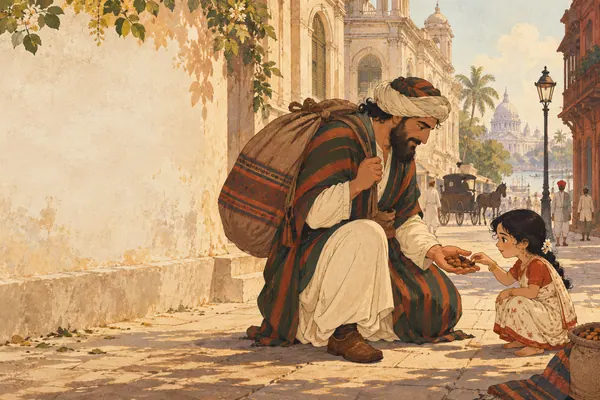
Kabuliwala is Rabindranath Tagore’s timeless 1892 Bengali short story celebrating the unlikely friendship between five-year-old Mini and Rahmat, a dry-fruit seller from Afghanistan. Listen to the complete Hindi narration by Roshni on YouTube and Spotify.