Novel · Amrita Pritam · 1950
Pinjar by Amrita Pritam: Summary & Hindi Audiobook
Quick Answer
Pinjar is Amrita Pritam’s landmark 1950 Partition novel, following Puro and Rashid through abduction, exile, and the upheaval of 1947. Read the guide in English here, and listen to the complete 5-part audiobook narrated in Hindi by Roshni on YouTube and Spotify.
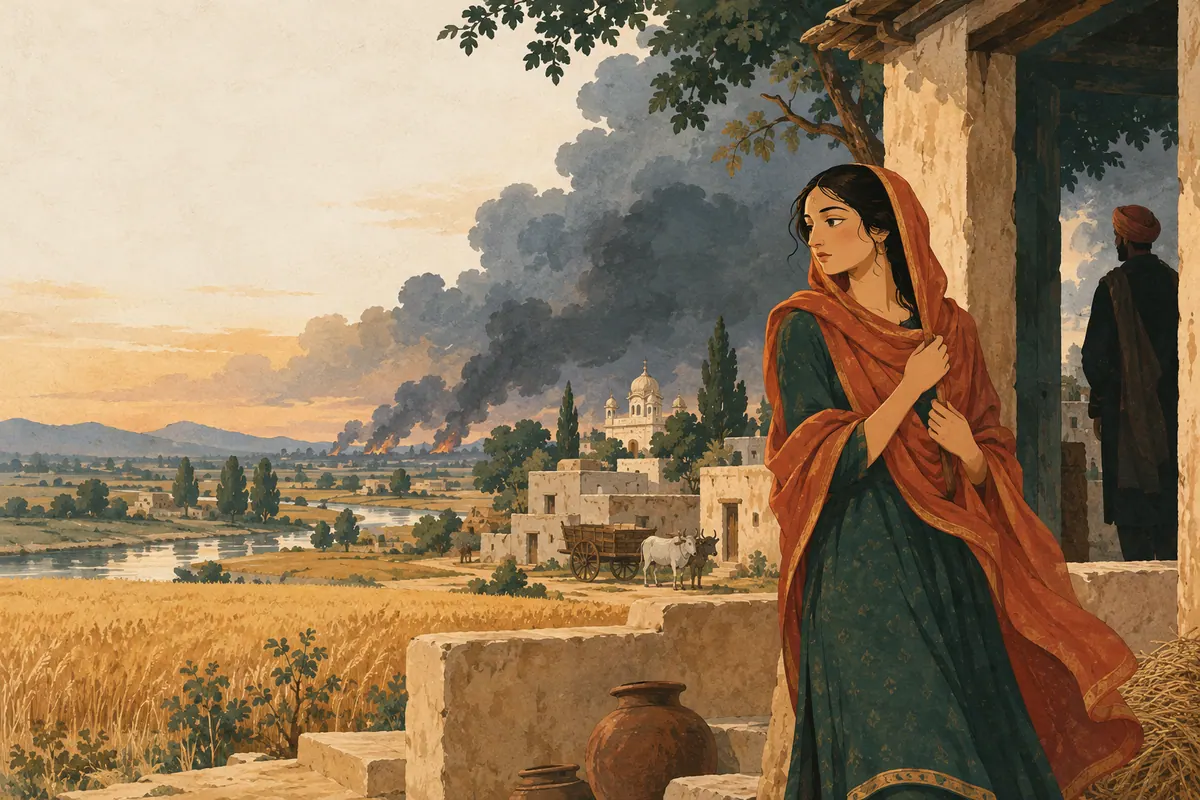
Hello friends, I’m your friend Roshni. Sometimes history leaves behind stories buried in its margins that continue to shake us long after the decades have passed. Today we listen to one such silenced voice caught in the fire of Partition.
We are stepping into Amrita Pritam’s celebrated 1950 novel, Pinjar (The Skeleton). More than a work of fiction, it carries the grief of countless women who endured the harshest face of 1947. When a person loses her home, her identity, and even her own name in a single night, what road does life take from there?
Puro’s journey in Pinjar is not only a portrait of helplessness; it is a quiet struggle that still asks hard questions of our society. Let’s begin our time together and walk back into the villages of undivided Punjab, where love, hatred, and humanity were all put on trial at once — narrated in Hindi on Baatcheet.
Listen in Roshni’s voice (Hindi audio)

Narrated complete in Hindi across 5 parts by Roshni on YouTube and Spotify.
Pinjar — Spoiler-free summary
Pinjar, written by Amrita Pritam in 1950, opens in a small village in undivided Punjab during the 1940s. At its center is Puro, a warm, spirited young woman engaged to Ramchand, a thoughtful young man. Her family is happily immersed in wedding preparations.
Beneath that joy lies an old family feud. Seeking revenge for a past insult to his family, Rashid abducts Puro. In a single stroke, Puro’s sheltered life shatters, setting her on an unfamiliar and painful path.
In Rashid’s captivity, Puro endures a suffocating loss of self. Her former identity is erased and she is given a new name, Hamida. Yet the deepest blow comes when Puro gathers the courage to escape back to her parents’ home at night. Fearing social disgrace and clinging to a brittle notion of honor, her own family turns her away. Those closed doors force her back to Rashid.
As the novel moves forward, the storm of the 1947 Partition arrives. Alongside the shifting tension between Puro and Rashid, the country itself is torn apart by riots, bloodshed, and mass displacement. Amid this turmoil, Rashid is consumed by remorse. Quietly eaten away by guilt, he finds himself undone by Puro’s silent tears.
Can Puro ever recover from what was taken from her? Will Rashid’s remorse change the bond between them? And when Partition reshapes every border, what choice will Puro make for her own future? These questions make Pinjar an unforgettable novel — one that is not merely heard, but lived.
Full plot summary and ending (spoilers)
If you are experiencing this story for the first time, listen to the Hindi audio on YouTube first — the ending lands best there. Then come back here.
Yes, show the full plot and ending
Amrita Pritam’s Pinjar is widely known as a Partition novel, though its reach goes deeper still. Set in 1940s undivided Punjab, it introduces Puro, an innocent, lively young woman happily anticipating her marriage to Ramchand, a gentle and principled young man. Her home is filled with song and celebration.
That happiness is shattered when Rashid abducts Puro to settle an old feud between their families. Rashid intends only to avenge his clan, yet his single act ruins Puro’s entire world. Held captive by him, Puro feels her very existence slipping away.
Summoning extraordinary courage, Puro escapes one night and runs back to her parents. There she meets society’s cruelest face: terrified of scandal and obsessed with appearances, her family refuses to take her back, telling her she is as good as dead to them. Broken by their rejection, Puro has no choice but to return to Rashid.
After her return, Puro’s old identity is stripped away altogether. Renamed Hamida, she must build a life alongside Rashid. Yet Rashid is fighting his own battle within. Having taken his revenge, he is haunted by Puro’s quiet endurance and unspoken tears. Guilt slowly turns into deep sorrow, tenderness, and genuine devotion toward her.
Some years later, the catastrophe of 1947 engulfs Punjab. Communal riots erupt, neighbors turn on one another, and violence spreads across the region. Amid the chaos, Puro — now Hamida — steps up to shelter and help other women devastated by abduction and displacement. Her own wounds give her the empathy to recognize theirs.
At Partition, Puro helps rescue Lajo, Ramchand’s sister and the wife of Puro’s brother. With Rashid’s help, she brings Lajo back to her family. At the refugee camp, Puro is offered a chance to leave with them.
Puro chooses to stay with Rashid. The decision belongs to her, even as the abduction and her family’s earlier rejection remain part of her history. Lajo’s return gives Puro a way to think about her own: when a woman makes it back to her family, a part of Puro makes it home with her.
Key characters
- Puro / Hamida
- The novel’s central figure — an innocent young woman who, after abduction and rejection by her own family, is forced to live a new life as Hamida. Her quiet resilience and compassion for other suffering women set her apart.
- Rashid
- The man who abducts Puro out of a family vendetta. Over time, deep remorse, empathy, and love for Puro take root in him, making him one of the novel’s most complex characters.
- Ramchand
- Puro’s fiancé, a calm and principled man. He never loses his affection for Puro and earnestly tries to welcome her back after Partition.
- Puro’s Family
- Her parents embody the hollow social codes of honor under which a daughter’s safety and suffering are treated as less important than reputation.
Themes
Is society’s hollow honor worth more than humanity?
Amrita Pritam’s novel exposes how rigid social rules crush basic human decency. When Puro risks her life to escape captivity and reaches her parents’ doorstep asking for shelter, her own father refuses to let her stay. To them, taking back an abducted daughter would ruin their standing in the village. Through this stark portrait of 1940s rural life, we see how a woman’s existence was treated not as her own life to live, but as a fragile token of family “honor.” The question Pritam raises still stings today whenever appearances outweigh compassion.
What did the fire of Partition take from ordinary people?
Set in undivided Punjab, Pinjar portrays the 1947 Partition not merely as a division of land, but as a rupture of human hearts. While Puro and Rashid wrestle with their private grief, an entire population is swept into communal violence and forced migration. Pritam shows how buried resentment erupts to erase centuries of shared life. Puro and Rashid’s personal story becomes part of a vast historical tragedy marked by refugee columns and bloodstained trains, as Puro herself witnesses the devastation of countless displaced women at the camps.
Can genuine remorse grow into love?
Through Rashid, Amrita Pritam explores the slow, painful work of conscience. Rashid abducts Puro to settle a family score, yet her silent tears and quiet dignity inflict a punishment he never anticipated. Seeing her trapped under his roof forces him to confront the gravity of what he has done. As the years pass, that remorse reshapes him, turning a relationship born of vengeance into unexpected tenderness and solidarity. During Partition, Rashid stands beside Puro as she rescues other women — showing that sincere repentance after a terrible wrong can still awaken real devotion.
A woman’s existence and the search for her own identity
At its core, Pinjar examines a woman’s struggle to claim an independent self in a world that denies her one. When Puro is forcibly renamed Hamida, she loses not only her name, but her faith, her choices, and her home — reduced to a pinjar, a mere skeleton shaped by other people’s rules. Yet by the end of the novel, that very “skeleton” separates her own truth from society’s empty expectations. When Ramchand and her parents offer to take her back, she chooses the life and identity she has forged on her own terms, turning a painful decision into an act of quiet autonomy.
Amrita Pritam
Amrita Pritam (1919–2005) was a vital voice in Punjabi and Hindi literature who brought women’s pain and unspoken struggles to generations of readers. Her pen carried the strength to tell hard truths without flinching. Having lived through the trauma of 1947 herself, when Amrita wrote Pinjar, it became more than a book — it spoke for countless women whose stories society wanted to bury. Honored with both the Sahitya Akademi Award and the Jnanpith Award, her work remains relevant because it compels us to stop and reflect. Listen to the full Hindi narration and share a thoughtful conversation about it with friends.
Why listen to this Hindi audiobook?
To understand a chapter of history that reshaped millions of lives, pause for a while and listen to this story. Experiencing Pinjar as a Hindi audiobook on Baatcheet is an immersive journey: in Roshni’s calm, expressive narration, every shift of grief, remorse, and quiet courage stays with you to the very end. All 5 parts are available in Hindi on YouTube and Spotify. Put on headphones for the best listening experience and let Amrita Pritam’s words sink in.
All parts — in Hindi on YouTube
- Pinjar · Part 138 min
- Pinjar · Part 242 min
- Pinjar · Part 348 min
- Pinjar · Part 437 min
- Pinjar · Part 528 min
Frequently asked questions
What is the story of Amrita Pritam’s novel Pinjar?
Amrita Pritam’s renowned 1950 novel Pinjar is set against the backdrop of the 1947 Partition, centering on Puro, a young woman abducted by Rashid over an old family feud. It closely examines a woman’s loss of agency alongside the collective grief of a divided land.
What happens between Puro and Rashid in Pinjar?
In Pinjar, Rashid separates Puro from her family and renames her Hamida. Yet Puro’s silent sorrow fills Rashid with deep guilt and remorse. By the time the 1947 Partition arrives, their relationship has become an unexpected bond of mutual support, and Puro ultimately refuses to leave him to return to Ramchand.
Is Pinjar available to read or listen to in Hindi?
Yes. Originally written in Punjabi in 1950, Amrita Pritam’s Pinjar is widely available in both Punjabi and Hindi. On Baatcheet, you can listen to the complete novel as a free 5-part Hindi audiobook narrated by Roshni.
Where can I listen to the Pinjar audiobook, and what language is the audio in?
The audio narration is in Hindi. You can listen to Roshni’s complete 5-part Hindi audiobook of Pinjar for free on Baatcheet’s YouTube channel, as well as on Spotify whenever you like.
Why doesn’t Puro return to her parents’ home?
When Puro escapes captivity and makes it back to her parents’ house, they refuse to take her in out of fear of gossip and social dishonor. They believe welcoming back an abducted daughter would ruin the family name — exposing society’s harsh double standards.
Why does Pinjar resonate with Global Indian adult listeners?
For Global Indian adults living abroad, Amrita Pritam’s Pinjar offers a profound connection to shared history, language, and Partition memory. Listening to the Hindi narration in Roshni’s voice on YouTube brings that era and its human cost close, no matter how far from home you are.
How does Pinjar end?
At the end of Pinjar, during the Partition refugee exchanges, Puro (Hamida) is reunited with Ramchand and her old family and given the freedom to return with them. Instead, she chooses to remain permanently with Rashid and the life she has built.
Listen next
Gunahon ka Devta
Dharamvir Bharati
Gunahon ka Devta is Dharamvir Bharati’s beloved 1949 Hindi novel tracing the tragic, unspoken love of Chander and Sudha against rigid social propriety in 1940s Allahabad. Listen to the complete 20-part Hindi audiobook and Roshni’s candid review on YouTube and Spotify.