Short Story · Edgar Allan Poe · 1843
The Tell-Tale Heart by Edgar Allan Poe: Summary & Hindi Audio
Quick Answer
The Tell-Tale Heart is Edgar Allan Poe’s chilling January 1843 psychological horror story following an unnamed murderer undone by paranoia, madness, and an imagined heartbeat beneath the floorboards. Listen to the complete Hindi narration by Roshni on YouTube and Spotify.
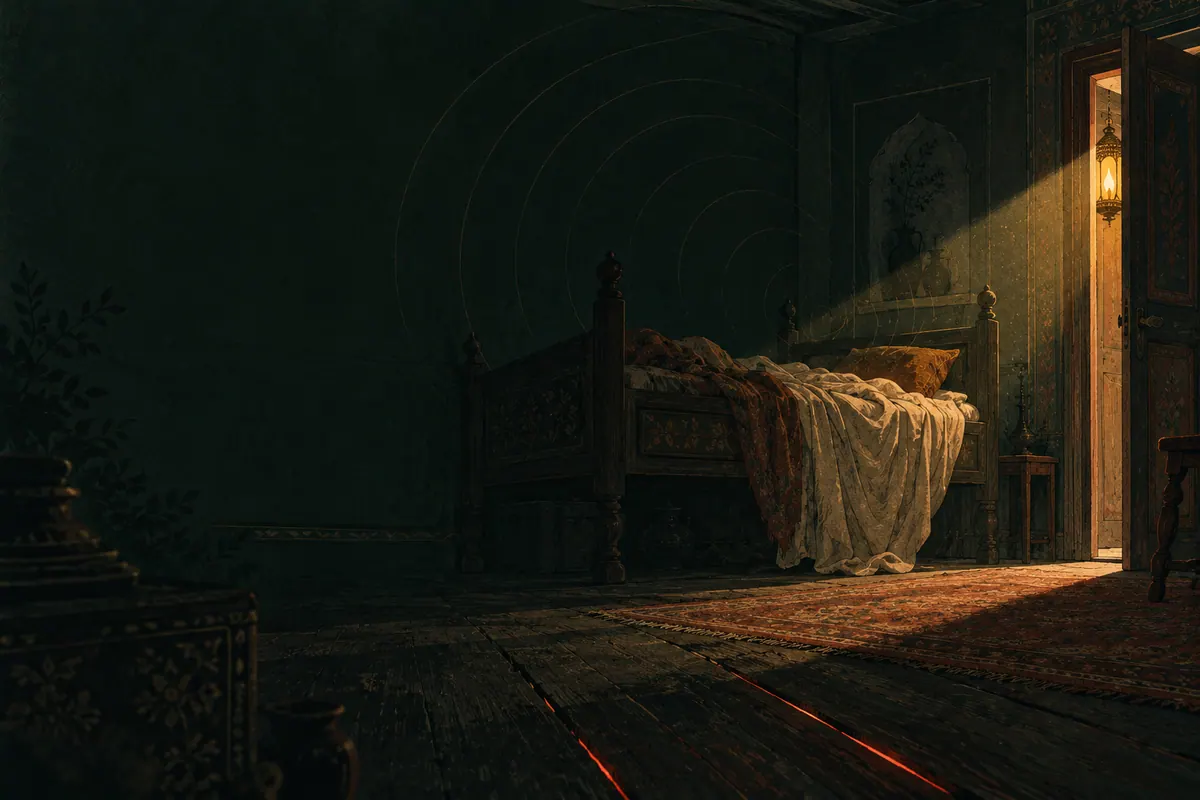
Hello friends, I’m your friend Roshni, back with a chilling classic sure to raise goosebumps. Have you ever imagined the sound of a beating heart driving someone to madness? Today we step into Edgar Allan Poe’s gripping 1843 psychological horror story, The Tell-Tale Heart.
This is no ordinary ghost story: it takes us straight into a darkened corner of the human mind where sanity, obsession, and guilt blur beyond recognition. Can anyone ever outrun their own conscience? Put on your headphones and listen in Hindi on Baatcheet.
Listen in Roshni’s voice (Hindi audio)

Narrated complete in Hindi as a single episode by Roshni on YouTube and Spotify.
The Tell-Tale Heart — Spoiler-free summary
Edgar Allan Poe’s The Tell-Tale Heart is told in the urgent voice of an unnamed narrator who insists from the opening sentence that he is completely sane — remarkably calm, careful, and acute of hearing — even as his feverish tone betrays a deeply fractured mind.
He lives with an old man against whom he holds neither grudge nor greed. Yet one detail obsesses him: the old man’s pale blue, film-covered “vulture eye.” Whenever it falls upon him, his blood runs cold — and solely to rid himself of that gaze forever, he resolves to murder the old man.
With chilling pride, he recounts creeping into the old man’s dark bedroom at midnight for seven consecutive nights, always retreating because the dreaded eye remains shut. On the eighth night, however, a tiny slip wakes the old man. Pitch blackness fills the room until the narrator lets a single thread of lantern light fall squarely onto the wide-open vulture eye — and suddenly hears a low, rhythmic thumping, like a watch enveloped in cotton: the terrified pounding of the old man’s heart.
Does the narrator carry out his plan — and can he survive the silence that follows? Listen to Roshni’s Hindi narration to feel Poe’s mounting suspense firsthand.
Full plot summary and ending (spoilers)
If you are experiencing this story for the first time, listen to the Hindi audio on YouTube first — the ending lands best there. Then come back here.
Yes, show the full plot and ending
After stalking his victim for seven nights, the narrator of The Tell-Tale Heart stands in the pitch-black room on the eighth night as a single beam from his lantern strikes the old man’s open vulture eye. Hearing the old man’s terrified heartbeat grow louder and louder — and panicking that a neighbor will hear it — the narrator leaps forward, drags the old man to the floor, and pulls the heavy bed over him until the heart finally falls silent.
Boasting of his clinical precision, he dismembers the body cleanly without leaving a single drop of blood and conceals the remains beneath the bedroom’s wooden floorboards.
Around four in the morning, three police officers knock at the door: a neighbor heard a shriek in the night and reported suspected foul play. Brimming with smug confidence, the narrator welcomes them in, claiming he cried out in a nightmare and that the old man is away in the country. He invites the officers to rest in the very bedroom where the corpse lies hidden, placing his own chair directly over the boards concealing his crime.
The officers chat pleasantly, entirely satisfied. Yet as they sit, a faint, steady ringing rises in the narrator’s ears — the unmistakable dull throb of a watch enveloped in cotton. Growing steadily louder, the sound convinces him the dead man’s heart is pounding beneath the planks. He talks louder and paces wildly, convinced the smiling officers hear it too and are mocking his terror.
Crushed beneath guilt and paranoia, he snaps completely, shrieks out his confession, and commands the police to tear up the floorboards — proving that a guilty conscience is its own relentless judge.
Key characters
- The Narrator
- An unnamed, unreliable storyteller who insists on his own cleverness and sanity while obsession, paranoia, and guilt steadily unravel him.
- The Old Man
- A quiet, harmless elderly man whose pale blue “vulture eye” becomes the fatal focus of the narrator’s madness.
- The Police Officers
- Three officers who arrive at four in the morning after a neighbor’s report; their calm, casual presence intensifies the narrator’s mounting panic.
- The Neighbor
- An offstage resident who hears a shriek in the dead of night and summons the police, setting the final unraveling in motion.
Themes
Can madness disguise itself as reason?
Edgar Allan Poe’s The Tell-Tale Heart traps readers inside a mind that equates methodical planning with sanity. Every calm boast the narrator makes — stalking an innocent man for seven nights over an eye — only deepens the portrait of his unraveling.
The crushing weight of guilt and conscience
Convinced he has pulled off a spotless crime, the narrator is undone not by detectives, but by his own mind. The phantom heartbeat roaring under the floorboards embodies a conscience that refuses to stay buried.
Time, silence, and the ticking watch
Poe builds relentless tension through stillness and measured time — seven silent midnights, the agonizing wait on the eighth, and a heartbeat likened to a watch wrapped in cotton counting down toward exposure.
What does the old man’s “vulture eye” symbolize?
More than a physical blemish, the pale blue eye feels to the narrator like an accusing gaze peering into his darkest secrets — illustrating how paranoia projects inner terror onto an innocent target.
Edgar Allan Poe
Edgar Allan Poe (1809–1849) was an American writer, poet, and critic revered as a master of macabre and psychological fiction as well as a pioneer of the detective story. Works such as The Tell-Tale Heart (January 1843), The Fall of the House of Usher, and The Raven endure because they probe the darkest recesses of the human mind rather than relying on simple scares.
Why listen to this Hindi audiobook?
Roshni’s measured, atmospheric Hindi narration sharpens every creak of suspense in Edgar Allan Poe’s classic thriller. Complete in a single gripping episode on YouTube and Spotify, The Tell-Tale Heart (Dil ki Dhadkan ka Raaz) is best experienced with headphones in a quiet room.
Frequently asked questions
What is the summary of The Tell-Tale Heart?
In Edgar Allan Poe’s The Tell-Tale Heart, an unnamed narrator murders an old man solely because of his pale blue “vulture eye” and hides the body beneath the floorboards, only to confess to police when guilt makes him hear the dead man’s heart still beating.
Who wrote The Tell-Tale Heart, and when was it published?
The Tell-Tale Heart was written by American author Edgar Allan Poe and first published in January 1843. It remains a cornerstone of psychological horror.
Where can I listen to The Tell-Tale Heart in Hindi audio?
You can listen to Roshni’s complete single-episode Hindi narration of Edgar Allan Poe’s The Tell-Tale Heart for free on Baatcheet’s YouTube channel and Spotify podcast.
Why does the narrator murder the old man?
The narrator holds no personal hatred or desire for money; he becomes irrationally obsessed with the old man’s pale blue, vulture-like eye and kills him simply to be rid of its gaze.
How does The Tell-Tale Heart end?
While three visiting police officers sit chatting in the bedroom above the hidden corpse, the narrator hears an ever-louder phantom heartbeat beneath the planks and breaks down under guilt, confessing everything.
Why is listening to The Tell-Tale Heart in Hindi engaging for Global Indians?
For Global Indian adult listeners abroad, hearing a world-famous Gothic classic narrated expressively in Hindi by Roshni offers a vivid blend of literary suspense and connection to their language.
Listen next

The Postmaster
Rabindranath Tagore
Rabindranath Tagore’s The Postmaster (1891) tells the tender story of a lonely Calcutta clerk posted to a remote Bengal village and Ratan, the orphaned girl who cares for him. Listen to the complete Hindi audio narration by Roshni on YouTube and Spotify.